The Anatomy of Excellence: A Connoisseur's Field Guide to Decoding Garment Quality
The gap between a well-made garment and an exceptional one is rarely visible at a glance. It lives instead in a series of details so specific, so technically demanding, and so deliberately understated that most consumers walk past them without recognition. This is not an accident of design. It is, in fact, the point. True quality does not announce itself. It rewards the observer who knows where to look.
What follows is a practical guide to developing that observational vocabulary — a framework for evaluating garments at every price point with the precision and confidence of someone who understands not merely what looks good, but why.
Begin With the Fabric: Weight, Drape, and Recovery
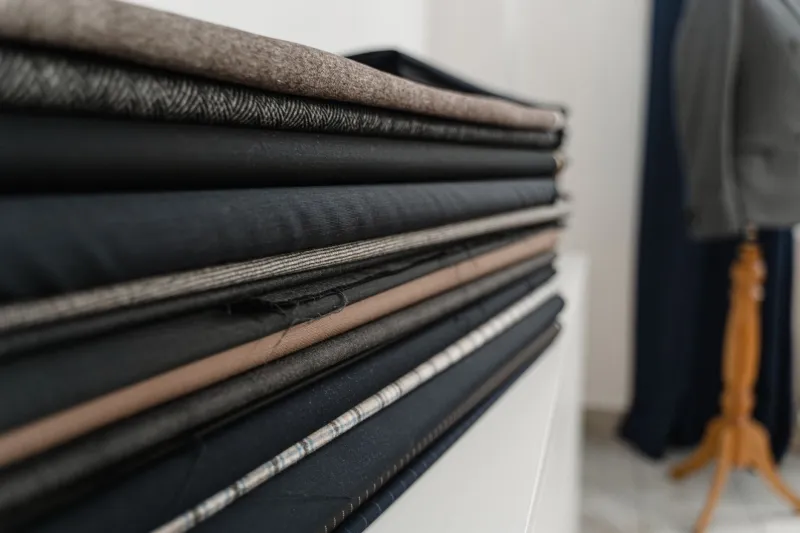
Every assessment of garment quality begins with the fabric, and the fabric must be evaluated by hand before it is evaluated by eye. Lift the material between your fingers and assess its weight. Quality textiles — whether wool, silk, cotton, or linen — possess a substance that synthetic blends cannot replicate. This is not merely a matter of composition; it is a matter of fiber length, yarn construction, and finishing processes that collectively determine how a fabric moves, how it holds its shape, and how it ages.
Next, assess drape. Hold a section of the fabric loosely and observe how it falls. Natural fibers with proper weight and weave structure will fall in smooth, continuous curves. Inferior fabrics — regardless of their fiber content — will break into angular folds, catch unevenly, or cling in ways that disrupt the garment's intended silhouette.
Finally, perform what textile professionals call a recovery test. Gather a portion of the fabric firmly in your fist, hold it for five seconds, and release. A high-quality fabric will return to its original configuration with minimal residual wrinkling. This single test reveals more about a fabric's long-term performance than any label specification.
Examine the Seams: Where Construction Becomes Visible
If fabric is a garment's foundation, its seams are its architecture. Turn the piece inside out and examine every seam you can access. Several specific characteristics merit attention.
Seam allowance — the margin of fabric between the stitching line and the raw edge — should be generous: a minimum of five-eighths of an inch on quality ready-to-wear, and often considerably more on tailored pieces. A narrow seam allowance signals that the manufacturer has prioritized material economy over longevity and future alterability.
Seam finishing refers to the treatment of raw fabric edges to prevent fraying. The hierarchy of finishing quality runs from unfinished edges (unacceptable at any price point) through serged or overlocked edges (acceptable at mid-market), bound edges in a complementary fabric (superior), and hand-stitched French seams or fell seams (indicative of exceptional construction). On a well-made shirt or blouse, French seams — where the raw edges are entirely enclosed within the seam itself — are the mark of a maker who refuses shortcuts.
Stitch density is the number of stitches per inch, and it matters because it determines the strength and durability of every seam in the garment. Quality construction typically runs between twelve and fifteen stitches per inch on straight seams. Fewer stitches indicate a faster, cheaper process; more may indicate an attempt to compensate for inferior thread tension.
The Tailored Piece: Reading Chest Canvas and Shoulder Construction
For structured garments — blazers, suit jackets, and formal coats — the most significant quality indicator is one that is entirely invisible from the outside: the chest canvas.
A fully canvassed jacket contains a layer of woven horsehair canvas that is hand-stitched to the front panel of the jacket, running from the shoulder through the chest and lapel. This canvas molds itself to the wearer's body over time, creating a fit and drape that becomes increasingly personal with wear. It is the defining characteristic of genuine tailoring and the feature most directly responsible for the way a quality jacket appears to float on the body rather than sit upon it.
A fused jacket, by contrast, uses a heat-bonded interlining that is adhered directly to the face fabric. It is faster to produce, less expensive, and initially presents a clean, crisp appearance. Over time, however, fusing separates from the face fabric — particularly after dry cleaning — producing the characteristic bubbling effect that marks an aging garment as inferior.
To test for canvas, pinch the lapel between your thumb and forefinger and roll the layers gently against each other. In a canvassed jacket, you will feel three distinct layers moving independently: the face fabric, the canvas, and the lining. In a fused jacket, the face fabric and interlining will move as a single, slightly stiff unit.
Shoulder construction deserves equal attention. A quality shoulder will be smooth from every angle, with the sleeve head setting cleanly into the armhole without puckering, pulling, or the telltale rippling that indicates a sleeve set under tension. The shoulder seam itself should sit precisely at the shoulder point — not forward, not behind — and the sleeve should hang with a slight forward pitch that accommodates the natural position of the arm at rest.
Finishing Details: The Last Five Percent
The final indicators of quality are what craftspeople sometimes call the finishing details — the elements applied at the end of production that require the most time and the least machinery. They are also the elements most readily sacrificed when manufacturers face cost pressure.
Buttonholes are among the most reliable quality indicators on any structured garment. A hand-worked buttonhole — distinguished by the gimp thread that runs along its edge, giving it a slightly raised, rounded profile — requires skilled labor and cannot be replicated at speed. Machine-worked buttonholes are flat, slightly compressed, and uniform in a way that reads as mechanical rather than considered. On a suit jacket or fine dress shirt, hand-worked buttonholes justify a significant portion of the price premium.
Pattern matching at seams — particularly at side seams, sleeve seams, and pocket placements on plaid, stripe, or checked fabrics — requires additional material and careful cutting. It is never strictly necessary and always indicates a maker's commitment to visual coherence over production efficiency.
Lining quality is frequently treated as invisible and therefore irrelevant. It is neither. A quality lining — in silk, silk-blend, or high-quality Bemberg — breathes, moves smoothly against clothing beneath it, and ages gracefully. A cheap lining tears at stress points, clings uncomfortably, and frequently outlives its appearance long before the garment itself shows wear.
Developing the Eye
The observational skills described here are not innate. They are cultivated through repeated, deliberate examination — of pieces you own, pieces you encounter in stores, and pieces you encounter in the collections of friends or family who dress well. Every garment examined is a lesson, and the lesson compounds.
Begin by making a practice of examining the interior of every garment before you assess its exterior. Turn things inside out. Feel fabrics before you look at them. Test recovery before you assess drape. Ask, in every instance, not merely whether a piece looks beautiful but whether it is built to remain beautiful — through years of wearing, cleaning, and the ordinary indignities of a life actively lived.
This is the knowledge that transforms a consumer into a connoisseur. And it is, ultimately, the only reliable guide through the considerable noise of the modern luxury market.