The Invisible Layer: Curating Scent With the Same Rigor as a Wardrobe
A woman may spend an hour assembling an outfit — the wool coat pressed, the earrings weighed against the neckline — and then, in the final thirty seconds before leaving the house, reach blindly for the same bottle of perfume she has worn since college. It is the sartorial equivalent of hanging a masterpiece on the wall and forgetting to frame it.
Scent is the invisible layer of dressing, the one element of an ensemble that arrives before you do and lingers after you go. And increasingly, the most refined dressers in America are beginning to treat it the way they treat their closets: as something to be curated, not merely collected.
Why One Signature Scent Is No Longer Enough
For decades, the ideal was the signature fragrance — a single scent so faithful it became synonymous with the woman herself. There is romance in that notion, and it is not entirely wrong. But a signature alone is a one-note argument. The woman who wears the same heady amber to a July garden luncheon in Charleston that she wears to a February board meeting in Manhattan has, in effect, worn the same dress to both.
Context is the essence of elegance, and fragrance is not exempt. Temperature alters how a perfume behaves; occasion alters what it communicates. A wardrobe of three to five scents — each with a clear role — allows a woman to dress her presence as deliberately as her person.
The Architecture of a Fragrance Wardrobe
Think of it the way a stylist thinks of a capsule closet: a few foundational pieces, each chosen to perform a distinct function.
The Daylight Workhorse. A clean, restrained composition — citrus, white musk, a whisper of neroli — that reads as polished rather than perfumed. This is the fragrance equivalent of a well-cut white shirt: appropriate everywhere, noticed by no one, remembered by everyone.
The Evening Voice. Deeper and more deliberate. Iris, leather, incense, or a resinous amber. This is the scent worn when the lights are low and the stakes are personal — a dinner at Gramercy Tavern, an opening at the Art Institute.
The Seasonal Statement. A scent tied to time rather than task. Perhaps a green fig for high summer, or a smoky vetiver for the turn of autumn. These fragrances mark the calendar the way a camel coat marks October.
The Private Indulgence. One scent that belongs entirely to the wearer — soft, close to the skin, worn on quiet Sundays and long weekends away. Not every fragrance needs an audience.
Buying With Discernment
The principles that govern a good wardrobe purchase govern fragrance equally. Resist the impulse buy; a scent encountered on vacation will not smell the same in your own bathroom. Wear a sample for a full day before committing — perfume evolves on the skin over hours, and the drydown, not the opening, is what you will live with.
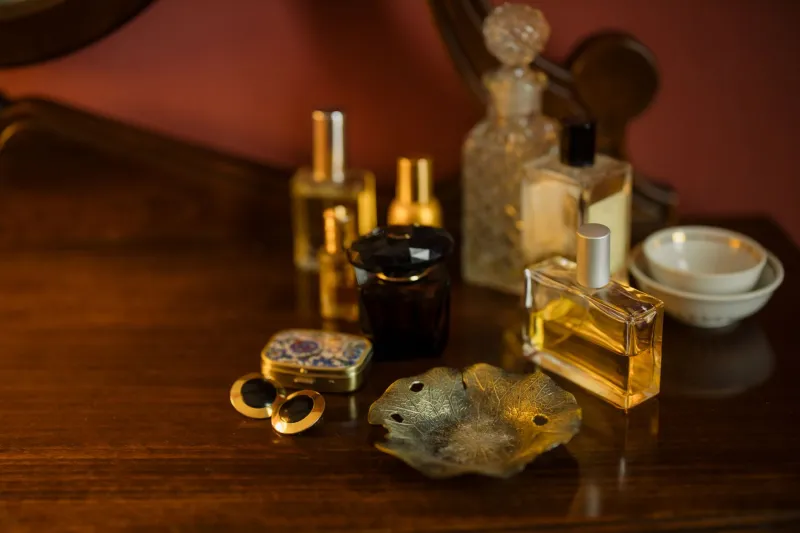
Buy the smaller bottle first. A fragrance, unlike a coat, does not improve with wear; it simply runs out. And store your bottles away from light and humidity — the vanity tray beside a steamy shower is a beautiful way to ruin them.
The Final Detail
There is a reason the French call the application of scent parfumer les vêtements — to perfume one's life. It is the last gesture of getting dressed, the one that cannot be photographed and cannot be faked. The truly elegant woman understands that refinement lives in the details no one can see. Her fragrance wardrobe is simply the proof.