Roots and Refinement: Reading the Regional Style Codes That Shape American Elegance
American fashion has long suffered from a peculiar inferiority complex—a tendency to defer to Paris, Milan, or London as the true arbiters of elegance while dismissing domestic style traditions as somehow less worthy of serious consideration. This is a mistake, and one that becomes apparent the moment you pay genuine attention to how Americans actually dress across the varied geography of this country.
From the weathered khakis of a Nantucket summer to the crisp seersucker of a Charleston garden party, from the architectural neutrals of a Los Angeles creative professional to the considered formality of a Washington, D.C. dinner, the United States contains within its borders a remarkable diversity of style traditions—each coherent, each internally consistent, and each offering a vocabulary from which any discerning dresser can draw.
Understanding these regional codes is not an exercise in costume or affectation. It is, rather, a method of developing what might be called style literacy: the ability to read the visual language of a place, to understand why certain choices are made, and to incorporate the most enduring elements of those traditions into a personal aesthetic that feels both authentic and considered.
The New England Tradition: Earned Restraint
No American regional style tradition has been more influential, more studied, or more consistently misunderstood than that of New England. The preppy aesthetic—madras, grosgrain ribbon, whale-embroidered belts—represents only its most cartoonish surface expression. Beneath the caricature lies something more interesting: a style philosophy rooted in the idea that quality should be worn in, not worn out.
The New England tradition prizes longevity above novelty. A Barbour jacket that has weathered ten seasons. A pair of Nantucket Reds faded to a dusty pink through genuine use rather than deliberate distressing. A Brooks Brothers Oxford cloth button-down that has been washed so many times it has achieved a particular softness no new shirt can replicate. The underlying message is not wealth, exactly—it is permanence. The suggestion that one's family has been wearing the same reliable things for so long that fashion, as a concept, has simply ceased to be relevant.
For the discerning dresser, the New England tradition offers several enduring lessons. The first is the value of natural fiber in classic silhouettes: shetland wool crewnecks, cotton chinos, linen blazers in summer. The second is the sophisticated use of color—the palette runs from navy and white through hunter green and burgundy to the warm tans and creams of natural materials. The third, and perhaps most transferable, is the principle of investment in quality basics that accumulate character rather than depreciate.
The Charleston School: Formality as Hospitality
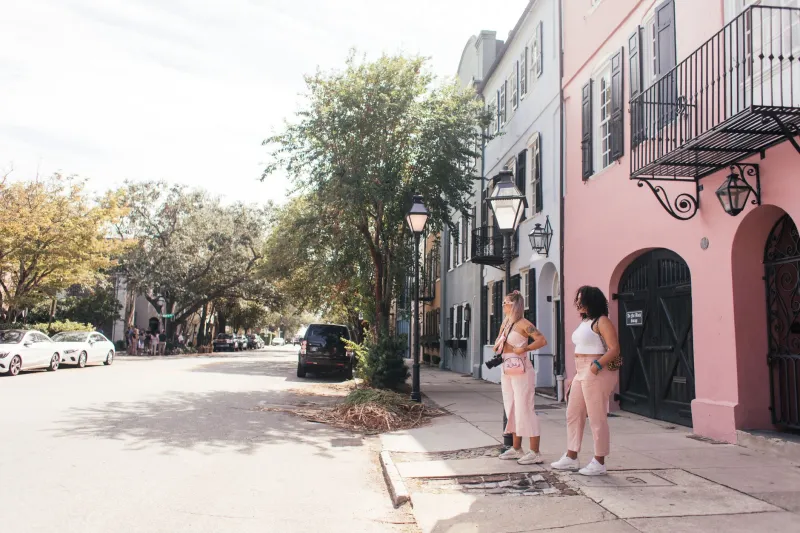
If New England style is defined by restraint, the sartorial tradition of the American South—and Charleston, South Carolina represents its most refined expression—is defined by a different but equally sophisticated principle: the idea that dressing well is an act of respect for the people in whose company one finds oneself.
Southern formality is not stiffness. It is warmth expressed through effort. The Charleston gentleman in a cream linen suit and a perfectly knotted tie at a summer luncheon is not performing status; he is performing hospitality. The woman in a printed silk dress and heeled sandals at a garden party is communicating, through her dress, that the occasion—and the people attending it—merited preparation.
The practical vocabulary of this tradition includes a commitment to occasion dressing that has largely been abandoned in other parts of the country. Hats are worn, and worn properly. Gloves appear at appropriate moments. Jewelry is real, meaningful, and often inherited. Color is embraced—the Southern palette runs to warm whites, peacock blues, and the particular coral-adjacent pink of a Confederate jasmine bloom—but always within a framework of proportion and appropriateness.
For those outside the South seeking to incorporate these lessons, the most valuable takeaway is the concept of dressing to the occasion rather than defaulting to the minimum acceptable standard. In a culture that has progressively lowered its expectations for dress, choosing to meet an occasion with genuine sartorial intention is itself an act of distinction.
California Understated: Luxury Without Effort
The California style tradition occupies a peculiar position in American fashion: it is simultaneously the most copied and the least understood. The copies tend to reproduce the surface elements—the relaxed silhouettes, the neutral palette, the expensive-looking casualness—without grasping the underlying logic.
California elegance, at its most sophisticated, is not about looking like you didn't try. It is about trying so well that the effort becomes invisible. The linen trousers that drape perfectly are not inexpensive; they are simply cut in a way that makes them appear effortless. The cashmere sweatshirt in a precise shade of oatmeal is not a casual choice; it is the result of knowing exactly what you look like in that color, in that weight of fabric, against the light of a particular environment.
The California tradition also reflects its geography in ways worth understanding. The light of the West Coast is different—brighter, more horizontal in the golden hours—and the colors that read as elegant there (warm whites, sage greens, the particular dusty terracotta of the hills in August) can appear flat or washed out in the gray light of the Northeast. Style literacy includes understanding how regional light conditions shape regional color palettes.
The transferable lessons from California understated are the value of fit over structure, the power of a precisely edited neutral palette, and the sophistication of knowing when not to add anything more.
The Washington Formality: Dress as Credibility
The nation's capital maintains a style tradition that is frequently maligned—often fairly—but which, at its best, embodies something genuinely important: the idea that dress communicates seriousness of purpose. The Washington professional in a well-cut navy suit is not being unimaginative; she is communicating, efficiently and effectively, that she is there to work, and that she understands the stakes of the work.
This tradition rewards quality in the places it shows—fabric, fit, footwear—while maintaining a studied neutrality in everything else. It is a style code that prioritizes credibility over personality, and while it may not be the most expressive tradition on this list, it offers a masterclass in the power of understatement in high-stakes environments.
Building a Geographically Informed Personal Style
The most elegant approach to regional American style traditions is neither wholesale adoption nor casual dismissal. It is the kind of thoughtful borrowing that characterizes all sophisticated personal aesthetics: taking what is most enduring from each tradition, understanding why it works, and integrating it into a wardrobe that reflects both where you are and who you are.
This requires, first, genuine study. Spend time in the places whose traditions interest you. Observe not the tourists but the natives—the people who have been dressing this way their entire lives, for whom these choices are not affectations but inheritances. Notice what they actually wear, as opposed to what the popular imagination supposes they wear.
Then consider what resonates with your own life, climate, and sensibility. A New Englander transplanted to Atlanta might retain the navy blazer and the Oxford cloth shirt while abandoning the heavy wools in favor of lighter linens. A Californian in Chicago might adapt the neutral palette and the investment in quality basics while incorporating the structured outerwear the climate demands.
Personal style, at its most refined, is always a negotiation between where you come from, where you are, and who you are becoming. The regional traditions of American dress provide a rich and underutilized vocabulary for that negotiation—one that is distinctly, proudly, and elegantly our own.